
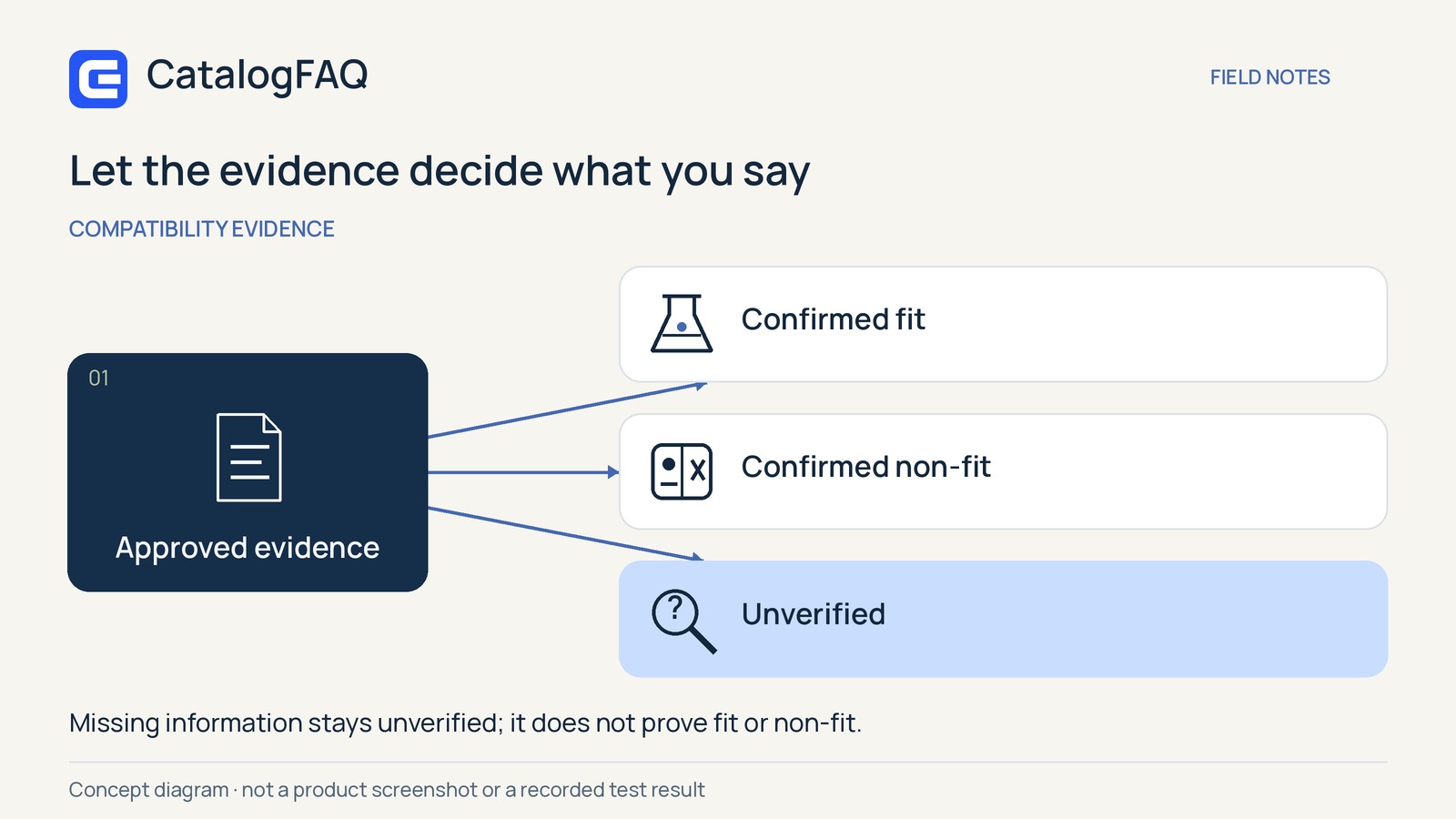
Answer “Will this fit?” with one of three evidence-based states: confirmed fit, confirmed non-fit, or unverified. If a model’s omission from a partial list is all you know, its status is unverified—not an automatic yes or no.
Start with one replacement part. Before editing its product compatibility FAQ, match each proposed claim to merchant-approved evidence for the exact part and model.
Build an evidence record before editing
Identify the part being sold by its manufacturer part number and store SKU. Record any variant the merchant says affects fit, then list the exact target models, preserving required suffixes, revisions or serial ranges.
Keep an internal spreadsheet with one row per part/model pairing. Record the source title, version or issue date, and relevant page or section. Add the supported conclusion and conditions, chosen status, reviewer, approval date and last review date. For unresolved pairings, record what is missing or conflicting.
Use current manufacturer documentation or merchant-approved technical records. Ask the merchant’s technical reviewer to confirm that each source supports the proposed conclusion. Similar names, visual resemblance and unsupported customer comments do not establish compatibility.
Choose the claim the evidence permits
- Confirmed fit: use when approved evidence supports the exact pairing. Carry every qualifying condition into the public answer.
- Confirmed non-fit: use when approved evidence explicitly excludes the pairing. Give a technical reason only if it is also supported.
- Unverified: use when there is no supported conclusion for the pairing, such as when identifiers are missing or records conflict.
Do not extend a conclusion about one model suffix to the whole family, or from one part variant to another.
For an unresolved pairing, say “We have not confirmed compatibility with this model.” Avoid “should fit” or “probably compatible.” Also avoid “not tested” unless the testing status is actually known: unverified describes the limits of the evidence, not what testing took place.
Turn the evidence record into public wording
Hypothetical example: All identifiers below are fictional. The replacement part is RP-8, sold under store SKU DEMO-RP8. Assume the merchant has approved fit with M-40A and an explicit exclusion for M-40B. M-41 and other models remain unverified.
For this example only, assume no additional revision or serial-range limits apply. Support has agreed to receive the full model identifier through the store’s support form.
The internal record would distinguish all three states:
- RP-8 / M-40A — confirmed fit: approval covers the exact model, including its A suffix.
- RP-8 / M-40B — confirmed non-fit: approved evidence explicitly excludes this pairing.
- RP-8 / M-41 — unverified: there is no approved fit or non-fit conclusion; record the evidence gap.
For each confirmed entry, fill in DOCUMENT TITLE, VERSION OR ISSUE DATE, PAGE OR SECTION and REVIEWER, APPROVAL DATE, LAST REVIEW DATE. These are placeholders, not citations or completed verification. Complete them from actual approved records before publishing your own claims.
The source references and approval details stay internal in this example. The public wording preserves the exact identifiers and limits:
Will replacement part RP-8 fit my model?
RP-8 is confirmed compatible with M-40A. The A suffix matters; this is not confirmation for the whole M-40 family. RP-8 is not compatible with M-40B.
We have not confirmed compatibility with M-41 or other models not named here. An unlisted model is not automatically incompatible, but it is not a confirmed match either.
For an unverified model, use our support form before choosing this part. Send the full model identifier, including any suffix, and mention RP-8. Support can review the available records but may still be unable to confirm a fit.
Agree a support handoff you can deliver
Agree with the technical reviewer which identifiers are necessary for this part. Depending on the approved documentation, that might mean a suffix, hardware revision or serial range. Do not request every field by default.
Assign an internal reviewer to handle unresolved enquiries, confirm the customer contact route, and put its actual name or location in the answer. Replace a vague “contact us” with what to send and where.
If no review route has been agreed, keep unresolved pairings unverified and omit the example’s support-form invitation. For those models, state that compatibility has not been confirmed without implying a review service exists.
Further review can remain inconclusive. Do not recommend buying or installing the part to find out. If new evidence establishes fit or non-fit, record its source and merchant approval before changing the public claim; an enquiry alone is not proof.
Check the answer before calling it finished
A signed-out visit checks the published wording, not technical compatibility.
Start with one replacement part: complete its evidence rows, agree the wording with the merchant’s reviewer, and verify that the published page says no more than those records support.